Selecting the right automatic irrigation filter is an important step in designing an efficient agricultural irrigation system. Water from rivers, reservoirs, wells, and other sources may contain sand, silt, algae, organic matter, and suspended particles. Without proper filtration, these contaminants can accumulate inside irrigation pipes, clog drippers, and affect water distribution across the field.
So, how do you select an automatic irrigation filter for agriculture? The most reliable approach is to evaluate the water source, irrigation flow rate, required filtration accuracy, operating pressure, and maintenance requirements together. A filter that matches these conditions can protect downstream equipment while keeping the irrigation system operating efficiently.
For agricultural projects using drip irrigation or micro-sprinkler systems, CHINADRIP provides several filtration options, including automatic self-cleaning disc filters, T-type and H-type automatic filtration systems, and manual disc filters. This guide explains how to compare these options and identify a suitable filtration solution.
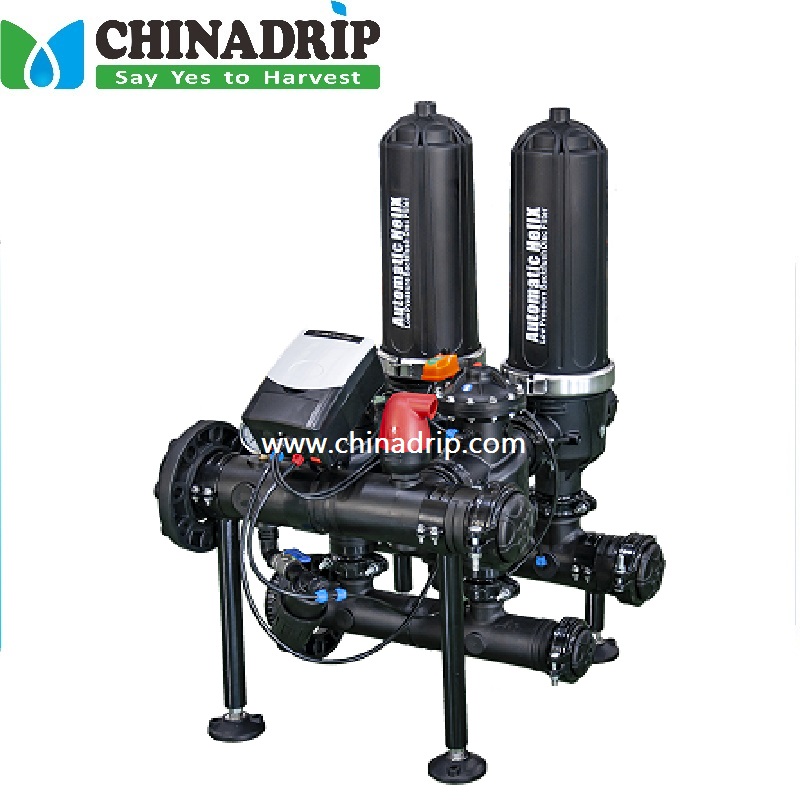
CHINADRIP automatic self-cleaning disc filtration equipment
Why Is an Automatic Irrigation Filter Important for Agriculture?
An automatic irrigation filter removes suspended contaminants from irrigation water before they enter the distribution network. Its main purpose is to reduce the risk of clogging and maintain consistent water delivery to crops.
This is particularly important in drip irrigation systems. Drippers contain relatively narrow internal water passages, which can become blocked when fine particles accumulate. Once clogging occurs, some plants may receive less water than others, affecting irrigation uniformity.
A properly selected agricultural water filtration system helps to:
-
Reduce sediment and suspended particles entering irrigation pipelines.
-
Lower the risk of dripper and micro-sprinkler clogging.
-
Reduce the frequency of manual filter cleaning.
-
Maintain more stable irrigation performance.
-
Protect downstream irrigation components and reduce maintenance interruptions.
Automatic filtration is especially useful for farms with large irrigation areas, continuous operation requirements, or water sources containing fluctuating amounts of suspended solids. However, automation alone does not guarantee good filtration. The filter type, filtration rating, and system capacity must all match the actual operating conditions.
Understand the Water Source Before Selecting a Filter
Water quality is one of the first factors to consider when choosing an agricultural irrigation filter. Different water sources introduce different types and quantities of contaminants, so the filtration solution should be selected according to the actual water conditions rather than the irrigation area alone.
Common agricultural water sources include:
River and canal water: Surface water may contain sand, silt, algae, leaves, and organic debris. Its quality can change significantly after rainfall or during different seasons. Projects using surface water should pay particular attention to sediment concentration and the need for regular flushing.
Reservoir and pond water: Stored water may contain algae, organic particles, and fine suspended solids. If biological contaminants are present, additional treatment or upstream screening may be necessary.
Well water: Groundwater is often relatively clear, but it may still contain sand, silt, or mineral particles. A water sample should be checked before deciding on the filtration method.
Recycled agricultural water: Reclaimed or reused water may contain suspended solids and organic matter. Its treatment requirements depend on the water quality and the intended irrigation application.
A practical recommendation is to test the water before purchasing a filter. Check suspended solids, particle size distribution, and the possibility of biological contamination. This information helps determine whether a disc filter is suitable as the primary filtration unit or whether additional pretreatment is required.
Choose the Right Filtration Type for Your Irrigation System
Agricultural irrigation filters are available in different configurations, including screen filters, disc filters, and media filters. Each type has different operating characteristics and is suitable for different water conditions.
Screen filters: These filters use a mesh screen to capture suspended particles. They are commonly used for relatively clean water and as secondary filtration equipment. Their performance depends on mesh size, filtration area, and cleaning frequency.
Disc filters: Disc filters use a stack of grooved discs to capture suspended particles. Water passes through the channels formed by the compressed discs, allowing contaminants to be retained on the filtration surfaces. Disc filters are widely used in agricultural drip irrigation systems.
Media filters: Media filtration uses a bed of filtering material to capture suspended solids and certain organic contaminants. It can be useful when surface water contains significant organic matter, although it generally requires a suitable backwashing arrangement.
For many agricultural drip irrigation projects, disc filtration is a practical choice because it provides a relatively large filtration surface and can handle suspended contaminants. CHINADRIP offers both automatic and manual disc filtration options for different system requirements.
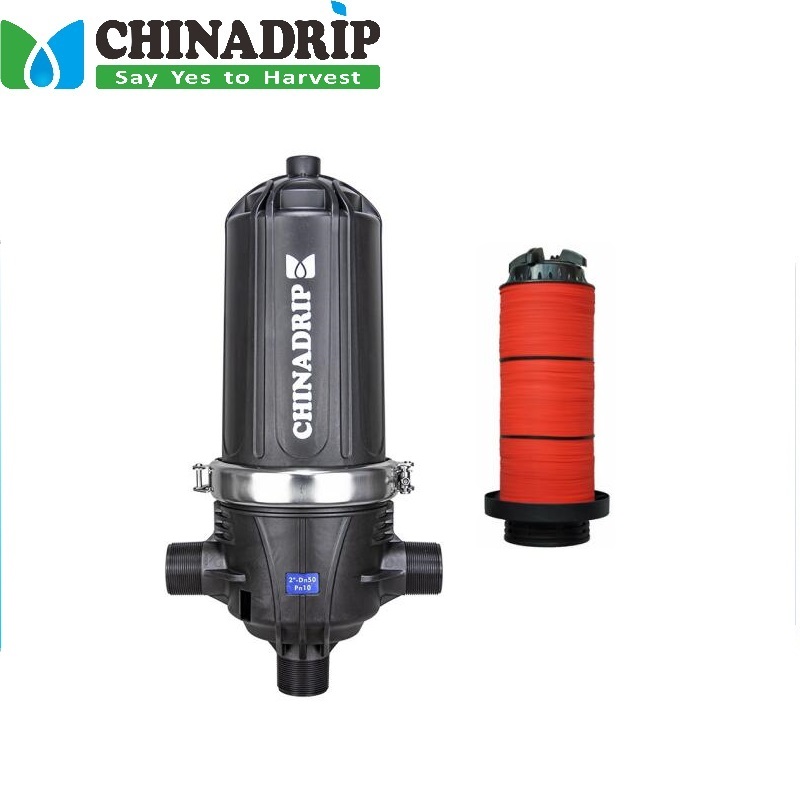
Manual disc filter for agricultural water filtration
For smaller irrigation projects or systems where manual maintenance is manageable, a manual disc filter for irrigation may be sufficient. Larger projects with frequent operation and higher maintenance demands may benefit from automatic self-cleaning filtration systems.
Determine the Required Filtration Accuracy
Filtration accuracy refers to the particle size a filter is designed to retain. It is commonly expressed in microns (μm) or mesh. Selecting the correct filtration rating is essential because the filter must be compatible with the smallest water passage in the irrigation system.
For example, drip tape, online drippers, pressure-compensating drippers, and micro-sprinklers may have different filtration requirements. A filter that is suitable for one irrigation component may not provide adequate protection for another.
When determining filtration accuracy, consider the following:
-
The minimum passage size of the dripper or sprinkler.
-
The type and size distribution of particles in the water.
-
The filtration recommendations from the irrigation equipment manufacturer.
-
Whether additional filtration stages are needed.
CHINADRIP's 2025 automatic self-cleaning disc filter catalog includes 80-mesh, 120-mesh, and 150-mesh configurations. The corresponding disc colors are green, red, and orange, respectively. Its technical catalog also provides a 130-micron head-loss reference chart for the listed filter configurations.
One important point: mesh and micron are not interchangeable numerical units. Their relationship depends on the mesh standard and wire dimensions. Therefore, buyers should confirm the actual filtration rating with the manufacturer rather than assuming that a particular mesh value always represents the same micron rating.
Calculate the Required Flow Rate and Filter Capacity
Flow rate is one of the most important technical parameters when selecting an automatic irrigation filter. The filter must handle the maximum water demand of the irrigation system without causing excessive pressure loss or restricting water delivery.
Before selecting a model, determine the total flow rate required by the irrigation zones operating simultaneously. Do not simply calculate the capacity based on the total farm area. The number of active irrigation zones, emitter discharge, and system operating schedule all affect the actual water demand.
A simplified calculation is:
Required System Flow Rate
Total Flow Rate = Number of Operating Emitters × Flow Rate per Emitter
Example: 10,000 emitters × 2 L/h = 20,000 L/h = 20 m³/h.
This example assumes all 10,000 emitters operate simultaneously. Actual system demand should also account for the irrigation zone layout, pump performance, and any additional water requirements.
CHINADRIP's T-series automatic self-clean filtration system is designed for system flow rates of approximately 40–180 m³/h on its product page. Its configurations include different numbers of filter units and manifold sizes, allowing buyers to compare system capacity with project requirements.
For example, the T-series catalog lists the following configurations:
|
Model
|
Filter Units
|
Manifold Size
|
Max. Flow
|
|
T202-3
|
2 × 2"
|
3" (DN80)
|
40 m³/h
|
|
T203-3
|
3 × 2"
|
3" (DN80)
|
60 m³/h
|
|
T204-4
|
4 × 2"
|
4" (DN100)
|
80 m³/h
|
|
T303-4
|
3 × 3"
|
4" (DN100)
|
90 m³/h
|
|
T304-6
|
4 × 3"
|
6" (DN150)
|
120 m³/h
|
|
T306-6
|
6 × 3"
|
6" (DN150)
|
180 m³/h
|
Source: CHINADRIP Filter System Catalog 2025. Values refer to listed maximum system flow rates.
These specifications provide a useful reference when comparing filter configurations. However, the selected model should also be checked against the required filtration accuracy, inlet pressure, backwashing conditions, and actual operating flow rate.
Check Operating Pressure and Pressure Loss
An irrigation filter does not operate independently of the pump and pipeline. Water pressure decreases as it passes through the filtration equipment, and this pressure loss must be considered during system design.
If the filter is undersized or becomes excessively clogged, the pressure difference between its inlet and outlet may increase. This can affect the pressure available to downstream irrigation equipment.
When comparing filter models, check:
-
Maximum allowable working pressure.
-
Pressure loss at the required operating flow rate.
-
Minimum pressure required for automatic backwashing.
-
Pump capacity during normal filtration and backwashing.
According to CHINADRIP's 2025 automatic self-cleaning disc filter catalog, the listed disc filter assemblies have a maximum operating pressure of 10 bar (145 psi). The catalog also specifies different minimum backwashing pressures and flow rates depending on the filter configuration.
For example, the catalog lists a minimum backwashing pressure of 0.8 bar for T2" and H3" filters, and 1.2 bar for T3" and H4" filters. Their corresponding minimum backwashing flow rates are 7, 8, 14, and 16 m³/h per filter, respectively.
These are technical requirements for the listed filter configurations, not universal settings for every irrigation system. Always verify the pressure and flow available at the filter outlet before selecting an automatic backwashing unit.
Automatic vs. Manual Irrigation Filters: Which Is Better?
The choice between an automatic and manual irrigation filter mainly depends on project scale, water quality, cleaning frequency, labor availability, and budget.
Manual disc filters require operators to clean the filter element when necessary. They are generally suitable for smaller agricultural projects, lower flow requirements, and systems where regular inspection and maintenance are convenient.
Automatic self-cleaning filters use a backwashing mechanism to remove accumulated contaminants from the filtration elements. They are more suitable for larger systems, continuous irrigation operations, and projects where reducing manual maintenance is a priority.
|
Comparison
|
Manual Filter
|
Automatic Filter
|
|
Cleaning
|
Manual cleaning
|
Automatic backwashing
|
|
Labor
|
More operator involvement
|
Reduced routine manual work
|
|
Application
|
Smaller or simpler systems
|
Larger or more demanding systems
|
|
Control
|
Operator controlled
|
Controller-based operation
|
|
Maintenance
|
Regular manual inspection
|
System inspection and backwash checks
|
CHINADRIP's T-series automatic filtration system integrates disc filter units, backwash hydraulic valves, and a controller. Its product documentation describes automatic backwashing based on the pressure difference between the inlet and outlet, helping reduce the need for frequent manual cleaning.
For projects requiring automatic filtration with a relatively compact configuration, buyers can review the T2 Automatic Self-Clean Filter System and compare its technical specifications with their project requirements.
Consider T-Type and H-Type Automatic Filtration Systems
For agricultural irrigation projects requiring automatic backwashing, CHINADRIP offers T-type and H-type filtration systems. Both are designed around automatic self-cleaning disc filter technology, but their configurations and available capacities differ.
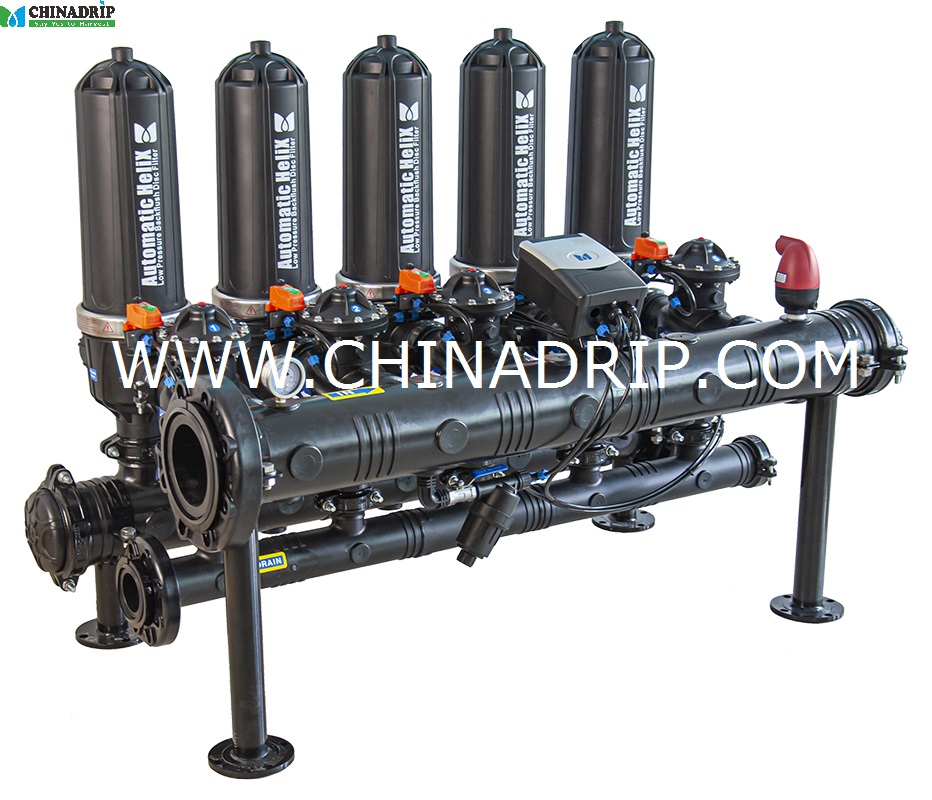
Multi-unit automatic filtration system
T-Type Automatic Self-Clean Filtration System
The T-series combines multiple 2-inch or 3-inch automatic backflush disc filter units, backwash hydraulic valves, and a controller. According to CHINADRIP's product information, the system is suitable for primary or secondary filtration in agricultural irrigation projects handling suspended contaminants. Its listed system flow range is 40–180 m³/h.
H-Type Automatic Self-Clean Filtration System
The H-series uses a different filter arrangement and is available in larger configurations. CHINADRIP's H4 product page lists a system flow range of 192–640 m³/h. This makes it an option worth evaluating for projects with substantial water demand. Final selection should be based on the detailed model configuration and the actual operating conditions.
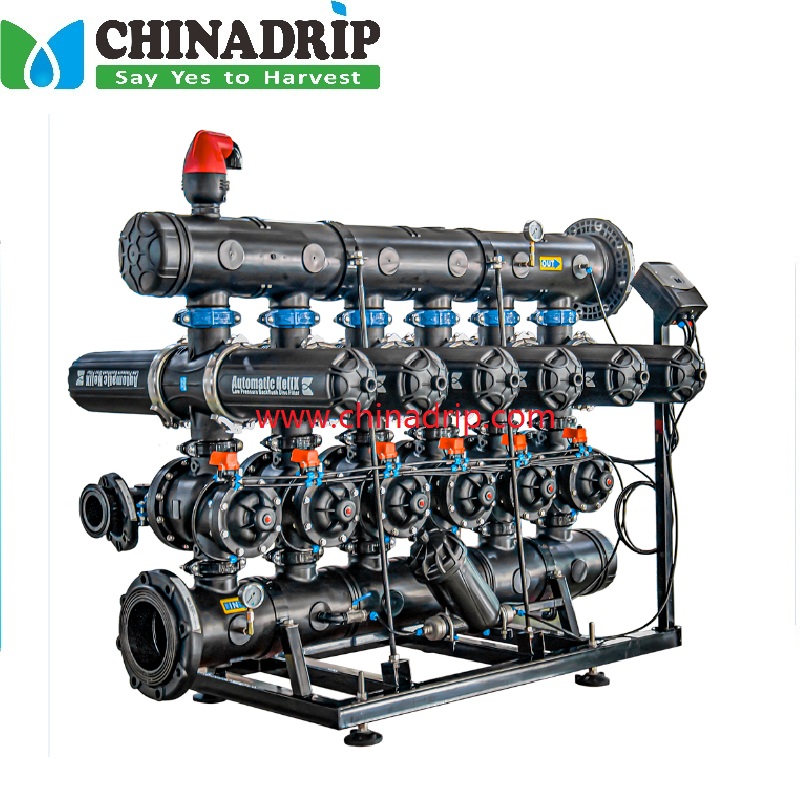
CHINADRIP H4 automatic self-clean filtration system
If your project has a relatively high water demand, you can explore the H4 Automatic Self-Clean Filtration System and request a configuration recommendation based on your required flow rate, pressure, and water quality.
Check the Backwashing System and Maintenance Requirements
Automatic backwashing is a key function of an automatic irrigation filter. During normal filtration, contaminants accumulate on the filter discs. When the pressure difference reaches the preset threshold, the controller activates the backwash valve and changes the water flow direction to clean the filter element.
In CHINADRIP's automatic self-cleaning disc filtration design, filtered water from other filter units is used to flush the discs in the unit undergoing backwashing. The loosened contaminants are then discharged through the backwash outlet.
Before purchasing an automatic filtration system, confirm the following details:
-
Whether backwashing is controlled by differential pressure, a timer, or both.
-
The minimum water pressure required during backwashing.
-
The backwashing flow rate required for each filter unit.
-
Whether the drainage system can handle the discharged water.
-
Whether the controller and backwash valves are compatible with the project configuration.
A properly designed backwashing system should clean the filter effectively without interrupting the overall irrigation operation more than necessary. Regular inspection is still important, especially when the source water contains high levels of sediment or organic matter.
Common Mistakes When Selecting an Agricultural Irrigation Filter
Choosing a filter based only on pipe diameter. A larger connection does not automatically mean the filter can meet the required flow rate. Check the manufacturer's flow and pressure specifications.
Ignoring the water source. A filter suitable for relatively clean well water may not be sufficient for river water containing heavy sediment or algae.
Selecting an excessively fine filtration rating. A finer rating is not always better. It may increase pressure loss and cleaning frequency if the water quality and filter capacity are not properly considered.
Ignoring backwashing requirements. Automatic filters still need sufficient pressure, flow, and proper drainage to complete the cleaning process.
Overlooking downstream irrigation components. The filter must be compatible with the drippers, drip tape, micro-sprinklers, and other equipment used in the system. Filtration should be designed around the complete irrigation network.
How to Select the Right Automatic Irrigation Filter from CHINADRIP
There is no single automatic irrigation filter suitable for every agricultural project. The correct solution depends on the combination of water quality, flow demand, filtration accuracy, operating pressure, and maintenance expectations.
For smaller agricultural irrigation systems, a manual disc filter may be sufficient when the water quality is manageable and regular cleaning is practical. For projects requiring reduced manual maintenance, an automatic self-cleaning disc filter is worth considering. Larger farms and irrigation networks with higher flow requirements may benefit from a multi-unit T-type or H-type automatic filtration system.
CHINADRIP specializes in agricultural drip irrigation and filtration equipment, offering a product range that includes disc filters, automatic filtration systems, drippers, micro-sprinklers, and related irrigation components.
To receive a more suitable filtration recommendation, prepare the following project information:
-
Water source: river, pond, reservoir, well, or recycled water.
-
Required operating flow rate (m³/h).
-
Required filtration accuracy (mesh or micron).
-
Available inlet pressure and working pressure.
-
Irrigation type and the number of operating zones.
With these details, CHINADRIP can help evaluate the appropriate filter configuration for your agricultural irrigation project. You can also explore the CHINADRIP irrigation product range to learn more about available filtration and irrigation solutions.
Frequently Asked Questions About Automatic Irrigation Filters
1. What is the best filter for agricultural drip irrigation?
Disc filters are a common choice for agricultural drip irrigation because their grooved discs can capture suspended particles. The best option depends on water quality, required filtration accuracy, system flow rate, and the specifications of the drippers.
2. How do I calculate the required capacity of an irrigation filter?
Calculate the total water demand of all irrigation zones operating simultaneously. Multiply the number of active emitters by their individual discharge rate, then compare the result with the filter's rated flow capacity and pressure-loss data.
3. What filtration mesh size is suitable for drip irrigation?
The required mesh size depends on the smallest water passage in the irrigation equipment and the particle characteristics of the source water. CHINADRIP's disc filter catalog includes 80-mesh, 120-mesh, and 150-mesh options. Always confirm the required rating with the dripper manufacturer.
4. What is the difference between an automatic and manual disc filter?
A manual disc filter requires an operator to clean the filter element, while an automatic disc filter uses a backwashing mechanism controlled by a filtration system. Automatic filters are generally more suitable for projects where frequent manual cleaning would be inconvenient.
5. How often should an automatic irrigation filter be backwashed?
Backwashing frequency depends on source water quality, suspended solids concentration, system flow rate, and the differential-pressure setting. Filters should be monitored and maintained according to the manufacturer's operating instructions rather than following one fixed cleaning interval.
6. What is the flow rate range of the CHINADRIP T-series automatic filtration system?
The CHINADRIP T2 product page lists a system flow rate of 40–180 m³/h. The exact capacity depends on the selected filter configuration, number of filter units, and operating conditions.
7. Is an automatic disc filter suitable for river water?
It can be suitable for river-water irrigation, depending on the concentration and type of contaminants. When the water contains large amounts of sand, algae, or organic debris, additional pretreatment may be necessary to protect the filtration equipment.
8. What information is needed to select an automatic irrigation filter?
The main information includes water source, water quality, required flow rate, filtration accuracy, working pressure, irrigation equipment type, and backwashing conditions. These parameters help determine the appropriate filter type and model.
Looking for an Agricultural Irrigation Filtration Solution?
CHINADRIP provides agricultural irrigation filters and automatic self-cleaning filtration systems for different project requirements. Contact our team with your water source, flow rate, and filtration requirements to discuss a suitable configuration.
Visit CHINADRIP
 English
 français
 русский
 español
 português
 Melayu
 ไทย
 Indonesia
 Việt Nam
 magyar
 ភាសាខ្មែរ



 Network Supported