How to Choose a Pressure Compensating Dripper Manufacturer
Table Of Contents
How to Choose a Pressure Compensating Dripper Manufacturer
November 27 , 2026
Discover Chinadrip, a professional irrigation equipment manufacturer in China, offering a wide range of drip irrigation products, filters, valves, and fittings with reliable manufacturing capabilities and customized solutions for global buyers.
Leon - Marketing Manager
Choosing a pressure compensating dripper manufacturer requires more than comparing unit prices. Buyers should evaluate the dripper’s discharge consistency, pressure compensation range, material suitability, filtration requirements, production quality control, and the supplier’s ability to support the intended irrigation system. A reliable manufacturer should provide verifiable technical data and samples that can be tested under the project’s actual operating conditions.
Pressure compensating (PC) drippers are designed to maintain relatively consistent water discharge as operating pressure changes within a specified range. They are commonly considered for orchards, greenhouses, nurseries, and fields where elevation differences or long irrigation lines can create pressure variation. The right supplier is one whose products match the project’s hydraulic requirements and whose specifications can be verified before bulk purchasing.
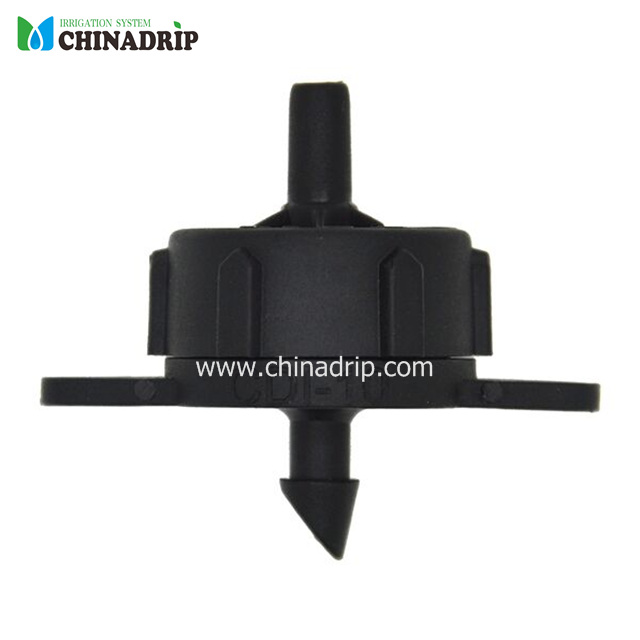
Pressure compensating dripper for agricultural irrigation.
Understand the Application Before Comparing Manufacturers
The first step is to define where and how the drippers will be used. A manufacturer cannot recommend a suitable product based on the term “pressure compensating” alone. Crop type, planting layout, water source, operating pressure, and irrigation method all affect product selection.
For example, orchards may use individual online drippers connected to small tubing, while greenhouse systems may require different emitter spacing and discharge rates. Sloping terrain introduces additional hydraulic considerations because elevation changes can create pressure differences across the irrigation network.
Before contacting suppliers, prepare the following project information:
Crop type, planting spacing, and irrigation layout.
Required emitter discharge and number of irrigation points.
Available inlet pressure and expected pressure variation.
Water quality and the planned filtration system.
Installation method, operating schedule, and maintenance requirements.
Expected order quantity, packaging needs, and delivery schedule.
This information allows buyers to compare manufacturers against the same technical requirements rather than relying on general product descriptions.
Check the Pressure Compensation Range and Flow Rate
A pressure compensating dripper should deliver a relatively stable flow rate within its specified operating pressure range. Buyers should check the complete pressure-flow relationship instead of relying only on a single nominal flow-rate value.
A manufacturer’s technical data should identify the nominal discharge, operating pressure range, and flow behavior at different pressures. If the product is intended for sloping fields or long laterals, the buyer should also consider how the system’s pressure variation compares with the dripper’s compensation range.
For example, Chinadrip lists a working pressure range of 0.5–4 bar for its openable pressure compensating on-line dripper. This is a product-specific specification, not a universal operating range for all PC drippers. Buyers should verify the current data for the exact product being evaluated.
A manufacturer should also explain how flow rate is measured and whether the stated value represents nominal discharge under a defined test pressure. This helps prevent confusion when comparing products from different suppliers.
Review the manufacturer’s pressure compensating dripper product range to identify the available product types and determine which specifications need to be confirmed for the project.
Evaluate Discharge Uniformity and Manufacturing Consistency
Discharge uniformity is one of the most important performance indicators for a pressure compensating dripper. Even when the average flow rate meets the requirement, excessive variation between individual emitters can lead to uneven water application across the crop area.
Manufacturing variation may arise from differences in component dimensions, material behavior, assembly, or the consistency of the internal flow path. Buyers should ask how the manufacturer monitors discharge variation and whether it can provide test data for representative production samples.
The coefficient of variation (CV) is commonly used to describe variation in emitter discharge. A lower CV indicates less variation in the tested sample, but the result should be interpreted alongside the test method, sample size, pressure, and product specification.
When evaluating a supplier, ask for the following information:
The method used to measure emitter discharge.
The number of samples included in a test.
The test pressure and water conditions.
The acceptance criteria for flow variation.
Whether test records can be linked to a production batch.
A manufacturer that can explain its testing process and provide relevant records gives buyers a stronger basis for evaluating product consistency than a supplier that offers only general quality claims.
Compare Dripper Designs for the Intended Irrigation System
Pressure compensating drippers are available in different designs, and each design should be evaluated according to the installation method, crop layout, and maintenance plan. Buyers should not assume that all PC drippers have the same connection, cleaning method, or shut-off behavior.
Online button drippers are installed as individual emitters and may be connected to small tubing or inserted into suitable irrigation pipes. Take-apart models can provide access to internal components for inspection and cleaning, depending on the design.
No-drain or anti-drain models are designed for applications where reducing drainage after irrigation stops is important. Their opening and closing behavior should be checked against the system’s operating pressure and elevation conditions.
For projects that require removable components, buyers can compare the design of openable pressure compensating on-line button drippers. Confirm the product’s pressure range, connection dimensions, flow rate, and maintenance requirements before placing an order.
The most suitable design is not necessarily the most complex one. It should meet the irrigation requirements while remaining practical to install, inspect, and maintain.
Review Material Quality and Resistance to Field Conditions
Material selection affects a dripper’s durability, dimensional stability, and suitability for outdoor use. Buyers should ask which materials are used for the body and internal components, and whether the material specifications are appropriate for the expected operating environment.
Agricultural irrigation products may be exposed to sunlight, temperature changes, fertilizers, and water containing dissolved minerals or suspended particles. Material suitability should therefore be evaluated in relation to the actual application rather than through broad claims such as “high quality” or “long life.”
Useful questions for the manufacturer include:
What material is used for the dripper body and internal parts?
Are material grades or technical data available for review?
What operating conditions are covered by the product specification?
Are there any restrictions on fertilizer or chemical compatibility?
How are material and component changes controlled between production batches?
For example, Chinadrip identifies polypropylene as the material used for its openable PC dripper product. Buyers should confirm the material and any application limitations for the exact model they intend to purchase.
Check Filtration Requirements and Clogging Resistance
A pressure compensating dripper can only perform reliably when the irrigation water is compatible with its internal flow passage and filtration requirements. Buyers should evaluate the manufacturer’s filtration recommendation alongside the water source and expected contaminant load.
Water from wells, reservoirs, rivers, or canals may contain different types of particles and organic matter. The appropriate filtration method depends on the water quality and the emitter’s technical requirements. A supplier should state the required filtration level and explain whether additional water treatment may be necessary.
Chinadrip lists a filtration requirement of above 120 mesh for certain PC dripper products. This requirement should be checked against the exact model and the irrigation water quality rather than applied automatically to every dripper.
Buyers should also ask how the manufacturer evaluates clogging resistance. A design described as self-cleaning or self-flushing does not eliminate the need for filtration, flushing, or maintenance. These features should be understood as part of the complete irrigation system.
For projects where filtration is a major concern, the manufacturer’s automatic self-clean filtration systems can be reviewed as part of the overall system design. Filter selection should be based on water quality, required flow, and the emitter manufacturer’s filtration recommendation.
Verify Quality Control and Production Traceability
A manufacturer’s quality control process should cover incoming materials, production operations, product inspection, and final shipment checks. Buyers should ask which inspections are performed and how nonconforming products are identified and handled.
For PC drippers, relevant checks may include dimensions, connection fit, visual defects, flow performance, and pressure-related behavior. The exact inspection plan depends on the product design and the manufacturer’s documented quality procedures.
Production traceability is also important for repeat orders. Buyers should clarify whether the manufacturer can identify production batches and retain inspection records. This can help investigate quality issues and compare performance between shipments.
Rather than relying only on a general quality certificate, request evidence that relates directly to the product being purchased. A supplier should be able to explain what its inspection records cover and which product or batch they represent.
Request Samples and Conduct Practical Performance Tests
Sample testing is an effective way to confirm whether a dripper meets the project’s requirements before a bulk order. The test should use the intended operating pressure, water conditions, tubing arrangement, and installation method wherever practical.
A useful sample evaluation can include the following checks:
Measure discharge at several points within the specified operating pressure range.
Compare flow rates among multiple drippers from the sample batch.
Check connections for fit, leakage, and installation difficulty.
Inspect the dripper for visible defects and confirm that the product matches the approved sample.
Where relevant, assess cleaning access and drainage behavior during start-up and shutdown.
Testing should be documented with the product identification, test conditions, measurements, and acceptance criteria. This creates a clear reference for comparing suppliers and approving the final product.
Evaluate Manufacturing Capacity and Supply Reliability
A suitable manufacturer should be able to explain how it will meet the project’s required quantity, delivery schedule, and packaging specifications. Buyers should distinguish between a supplier’s stated lead time for a particular order and a general promise of fast delivery.
Before placing a large order, confirm the production schedule, order quantity, packaging details, shipping terms, and procedure for handling changes. For repeat purchasing, clarify how the supplier manages product consistency and communicates changes to materials or specifications.
If the project involves a distributor or irrigation system integrator, discuss the availability of product documentation, labeling, and technical support. These details can affect installation planning and after-sales service.
Buyers should request a written quotation that identifies the exact product, flow rate, connection type, operating pressure range, quantity, packaging, and delivery terms. A detailed quotation reduces the risk of comparing different product configurations under the same generic name.
Compare Manufacturers Using a Structured Evaluation
A structured comparison helps buyers assess suppliers consistently and identify missing information before making a purchasing decision. The following checklist can be used during supplier qualification.
Evaluation area
What to verify
Evidence to request
Hydraulic performance
Flow rate and pressure compensation range.
Technical datasheet and pressure-flow data.
Discharge consistency
Variation between individual emitters.
Test method and representative flow test results.
Material suitability
Material specifications and application limitations.
Material data and product documentation.
Quality control
Inspection procedures and batch identification.
Inspection records and traceability information.
Supply capability
Order quantity, delivery schedule, and packaging.
Written quotation and confirmed production schedule.
Technical support
Availability of product guidance and issue resolution.
Technical documentation and support process.
The evaluation should prioritize technical suitability and verifiable quality evidence. Price is important, but a low unit price may not represent the best value if the product requires frequent replacement or does not meet the irrigation system’s performance requirements.
FAQ
What should I check first when choosing a pressure compensating dripper manufacturer?
Start with the product’s pressure compensation range, nominal flow rate, and discharge consistency. These specifications determine whether the dripper can meet the hydraulic requirements of the irrigation project. Then verify material suitability, filtration requirements, quality control, and supply capability.
What is the difference between a pressure compensating dripper and a standard dripper?
A pressure compensating dripper is designed to maintain relatively stable discharge within a specified pressure range. A standard non-compensating dripper generally has a flow rate that changes more directly with operating pressure. The appropriate choice depends on system pressure variation, field layout, and irrigation requirements.
How can I verify the quality of a PC dripper before bulk purchasing?
Request samples and test discharge at relevant operating pressures. Compare flow rates among multiple units, inspect connections, and review the manufacturer’s test records. The sample test conditions and acceptance criteria should be agreed upon before the order is placed.
Why is filtration important when selecting a pressure compensating dripper?
Small internal flow passages can be obstructed by particles or other contaminants. The required filtration level depends on the emitter design and water quality. Buyers should confirm the manufacturer’s filtration recommendation and ensure that the complete irrigation system can meet it.
Should I choose a take-apart pressure compensating dripper?
A take-apart design may be useful where inspection and cleaning access are important. However, buyers should confirm the cleaning procedure, connection compatibility, pressure range, and maintenance requirements. The best design is the one that fits the irrigation layout and operating plan.
Conclusion
Choosing a pressure compensating dripper manufacturer is a technical purchasing decision. Buyers should evaluate pressure-flow performance, discharge uniformity, material suitability, filtration requirements, quality control, and the supplier’s ability to deliver the specified product consistently.
A clear project specification, documented sample test, and written quotation provide a practical basis for supplier comparison. By confirming these details before bulk purchasing, agricultural buyers can reduce selection risks and choose a dripper that is suitable for the intended irrigation system.
 English
 français
 русский
 español
 português
 Melayu
 ไทย
 Indonesia
 Việt Nam
 magyar
 ភាសាខ្មែរ



 Network Supported